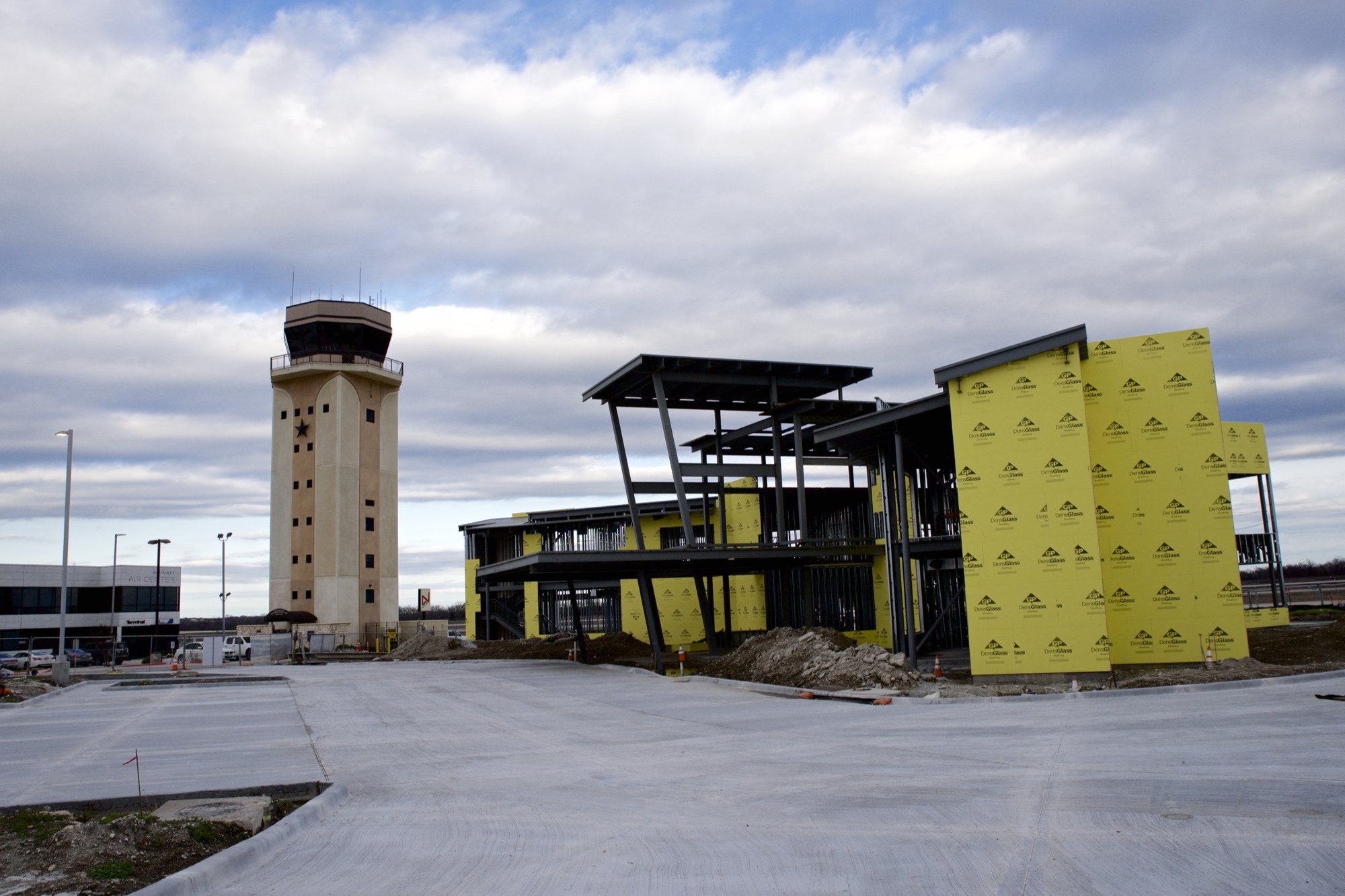
McKinney's First Commercial Flights Start Wednesday
On Wednesday, Veterans Day, the first commercial passenger flight is scheduled to leave McKinney National Airport. Avelo Airlines flies to Fort Myers, Florida. Avelo calls itself Collin County's "hometown airline," and McKinney becomes the third airport in the Dallas-Fort Worth area with commercial flights, alongside DFW International and Love Field.
I already wrote about the land next door when McKinney zoned about 724 acres for light industrial use. That piece was about the dirt. This one is about the schedule, because a real departure time gives buyers and users something concrete to look at.
What's Taking Off
The new passenger terminal is 46,000 square feet, with four gates that can grow to six, at 1910 FM 546. The city and airport have said it opens the same day service starts, Nov. 11.
Avelo's announced start dates, from its June 30 and Oct. 15 releases and the city's Sept. 24 release, look like this:
- Wednesday, Nov. 11: Fort Myers
- Thursday, Nov. 12: Las Vegas and Orlando
- Thursday, Nov. 19: Tampa and Fort Lauderdale
- Wednesday, Dec. 16: Atlanta, Denver, and Sarasota/Bradenton
- Thursday, Dec. 17: Nashville, New Orleans, and West Palm Beach
That is 11 nonstop destinations, according to Avelo's Oct. 15 announcement. Avelo notes schedules can change. The city said Sept. 24 that Avelo will base three 184-seat Boeing Next-Generation 737-800 jets at the airport and operate Wednesday through Monday. In October, Avelo said the McKinney investment would create about 150 jobs, including pilots, flight attendants, aircraft technicians, and airport staff. Earlier city and airline statements had put that figure at more than 100.
When you book, look for the code DTX. That is the International Air Transport Association code for commercial service. The airport keeps TKI as its FAA identifier for general aviation, which it has handled for more than 40 years and will keep handling.
How They Paid for It
This terminal did not come from a voter-approved airport bond. On May 6, 2023, McKinney voters rejected a $200 million bond that would have funded a larger commercial-service plan. City leaders later built a smaller project. Community Impact has reported the terminal and related infrastructure at $79 million, paid for with a mix of local city funds and grants.
That should sound familiar after this month's Collin County road-bond vote. A "no" at the ballot box does not always mean a project dies. Sometimes it means a smaller version, paid another way, on a longer path.
McKinney's fiscal year 2026-27 budget, as reported by Community Impact from Assistant City Manager Barry Shelton's Aug. 7 work-session comments, projects about $3 million in first-year revenue from the commercial terminal, from airline, concession, rental-car, and parking fees. The broader airport fund is projected at about $19.7 million in revenue and $20.8 million in expenses. Shelton said the city wants the airport to pay for itself within the first five years of commercial operations.
Parking starts at 980 spaces, with room to grow to 1,450. Airport Director Ken Carley told Community Impact the daily rate will be $15.
The Passenger Bet
Community Impact, citing a city statement, reported that Avelo expects to serve 260,000 passengers in the first year and reach 900,000 a year by year three. Those are projections, not counts. The first few months of actual bookings will tell us more than any forecast.
On Sept. 24, the FAA issued McKinney a Part 139 Airport Operating Certificate, which is what allows scheduled passenger airline service. The FAA said it was the first time a Texas airport had received one of those certificates since 2005. Ignacio Flores, director of the FAA's Southwest Region Airports division, told Community Impact it is rare for a general-aviation airport to convert into a fully certified commercial airport.
A 2025 environmental assessment for the terminal, as summarized by Community Impact, found that noise levels requiring mitigation are expected to stay on airport property. City Council has also authorized Kimley-Horn to update the airport master plan. Carley said the last update, in 2018, had only a small section on commercial service.
In a Nov. 6 NBC 5 report from the terminal, Carley called the opening a milestone and said the airport will watch how the community responds, then work with Avelo on adding routes if demand is there.
Why Nearby Land Just Changed
On Tuesday, Nov. 3, McKinney City Council annexed and zoned those three airport-area tracts, about 724 acres in all, as I1 Light Industrial: roughly 398.6 acres east of Enloe Road and south of U.S. 380, 175.9 acres north of FM 546 along County Road 722, and 149.8 acres at Enloe Road and County Road 327. Staff told council to expect development requests soon. The future Spur 399 corridor runs through that area. I walked through the details here: 724 Acres Next to McKinney's Airport Just Got a Job Title.
Here's how I'm reading Wednesday's first flight:
1. The promise now has a departure time. For years, commercial service at McKinney was a plan, a rendering, and a debate. Starting Wednesday it is a published schedule. Hotels, rental-car support, industrial users, and vendors who follow airline traffic now have actual flights to evaluate instead of a plan.
2. Zoned ground next to a working commercial airport is worth a fresh look. That 724 acres now has city light-industrial zoning next to an airport with scheduled flights. Whether users actually come, and what they pay, will depend on demand, utilities, and roads. None of that is guaranteed.
3. Roads still decide who wins. On Nov. 3, Collin County voters turned down Proposition B, the $475 million road bond, with 51.67% against in unofficial results. That puts more weight on corridors already in motion. In a December 2025 transportation update, the county said it had allocated $356 million to the U.S. 380 and Spur 399 freeways and was acquiring right-of-way for Spur 399 in McKinney. Those are the ones to watch if you own or want land on the east side.
4. This is phase one, not the finished airport. Four gates can become six. The parking lot can grow. The master plan is being rewritten around commercial service that, until now, was only a line in an old document. If the first-year numbers hold up, that will be one more data point for the next round of hangars, hotels, and industrial projects. If they don't, that matters too.
If you live or buy in McKinney, Princeton, Melissa, Anna, or east toward the airport from Frisco and Prosper, this may also change the trip. For some routes, you may not have to drive to DFW every time a site visit, a relative, or a deal takes you out of town.
Let's Talk
I've worked land and commercial deals across North Texas for more than 23 years, and I live and work right here in Prosper. If you own land near McKinney National Airport, or you're weighing a purchase on the east side, I'm glad to look at how this new schedule sits next to your tract.
Email me at Dan@CooperLandCompany.com or visit cooperlandcompany.com.
Sources
- Community Impact, "McKinney National Airport to launch commercial flights in November" (Nov. 4, 2026): https://communityimpact.com/mckinney/transportation/mckinney-national-airport-to-launch-commercial-flights-in-november/
- NBC 5, "McKinney National Airport prepares for first commercial passenger flights" (Nov. 6, 2026): https://www.nbcdfw.com/news/local/mckinney-national-airport-prepares-for-first-commercial-passenger-flights/4102769/
- Federal Aviation Administration, "FAA Grants Commercial Operating Certificate to McKinney National Airport" (Sept. 24, 2026): https://www.faa.gov/newsroom/faa-grants-commercial-operating-certificate-mckinney-national-airport
- City of McKinney news release, "McKinney National Airport Shares Terminal Progress and Avelo Airlines Announces More Routes From DTX" (Sept. 24, 2026): https://www.mckinneytexas.org/m/newsflash?cat=1 and https://flydtx.com/mckinney-national-airport-shares-terminal-progress-and-avelo-airlines-announces-more-routes-from-dtx/
- Community Impact, "FINAL: Collin County voters reject $817.5M bond" (updated Nov. 4, 2026): https://communityimpact.com/allen/election/early-election-results-show-all-collin-county-bond-propositions-failing/
- Collin County Commissioners Court, Transportation Update (Dec. 8, 2025): https://eagenda.collincountytx.gov/docs/2025/CC/20251208_3163/59256_Transportation%20Update%2C%2012-8-25v2.pdf
- MyOpenTexas summary of McKinney City Council Nov. 3, 2026 meeting (annexation/I1 zoning cases 26-0012A/26-0117Z, 26-0013A/26-0118Z, 26-0014A/26-0119Z): https://mckinney.myopentexas.org/meetings/3da9eed2-7c8d-434d-b39a-9727bab71185
- Avelo Airlines, "Avelo Airlines Becomes Collin County's Hometown Airline" (June 30, 2026): https://www.aveloair.com/company-news/avelo-airlines-becomes-collin-countys-hometown-airline-launching-nonstop-service-to-five-destinations-from-mckinney-national-airport
- Avelo Airlines, "Avelo Airlines Grows Again in Collin County — Adding Two New Florida Destinations at McKinney National Airport" (Oct. 15, 2026): https://www.aveloair.com/company-news/avelo-airlines-grows-again-in-collin-county-adding-two-new-florida-destinations-at-mckinney-national-airport
- Community Impact, "Cleared for takeoff: Work begins on 46,000-square-foot commercial terminal at McKinney National Airport" (Aug. 25, 2025): https://communityimpact.com/mckinney/development/cleared-for-takeoff-work-begins-on-46000-square-foot-commercial-terminal-at-mckinney-national-airport/
- Cooper Land Company, "724 Acres Next to McKinney's Airport Just Got a Job Title" (updated Nov. 4, 2026): https://www.cooperlandcompany.com/details/4273/724_Acres_Next_to_McKinney's_Airport_Just_Got_a_Job_Title:_What_Light_Industrial_Zoning_Means_for_East_McKinney_Land
Related Reading
- 724 Acres Next to McKinney's Airport Just Got a Job Title
- Collin County's $475M Road Bond Failed: What It Means for Land
Photo: Danazar / Wikimedia Commons, CC BY-SA 4.0 (resized). McKinney National Airport control tower, January 2020. Illustrative; not the 2026 commercial passenger terminal.
OUR LISTINGS

© 2026 Cooper Land Company
DMCA Notice | Terms & Services | Privacy Policy | Accessibility Statement
EQUAL HOUSING OPPORTUNITY




Cooper Land Company
2501 Greenspoint Ln, Prosper, TX 75078
Mobile: 214-714-5638
dan@cooperlandcompany.com